
For coffee exporters, importers and roasters
Add a regulation. Ethica does the rest.
Pick a law, a label or a buyer’s standard. Ethica’s AI works out what it needs, adds the data collection where that data lives in your supply chain, and builds the report. Two agents then watch the rules and every lot, 24/7. Try it here on two demo coffee corridors.
- 284 → 68
- questions → data points
- 65–70 %
- less time collecting data
- 24/7
- agents on rules and lots
- Offline
- grading at origin in the Origin app
Demo data · snapshot 22 Oct 2026 · Ethica dictionary v2.5.0 · rules researched 21 Oct 2026
1 Pick a corridor
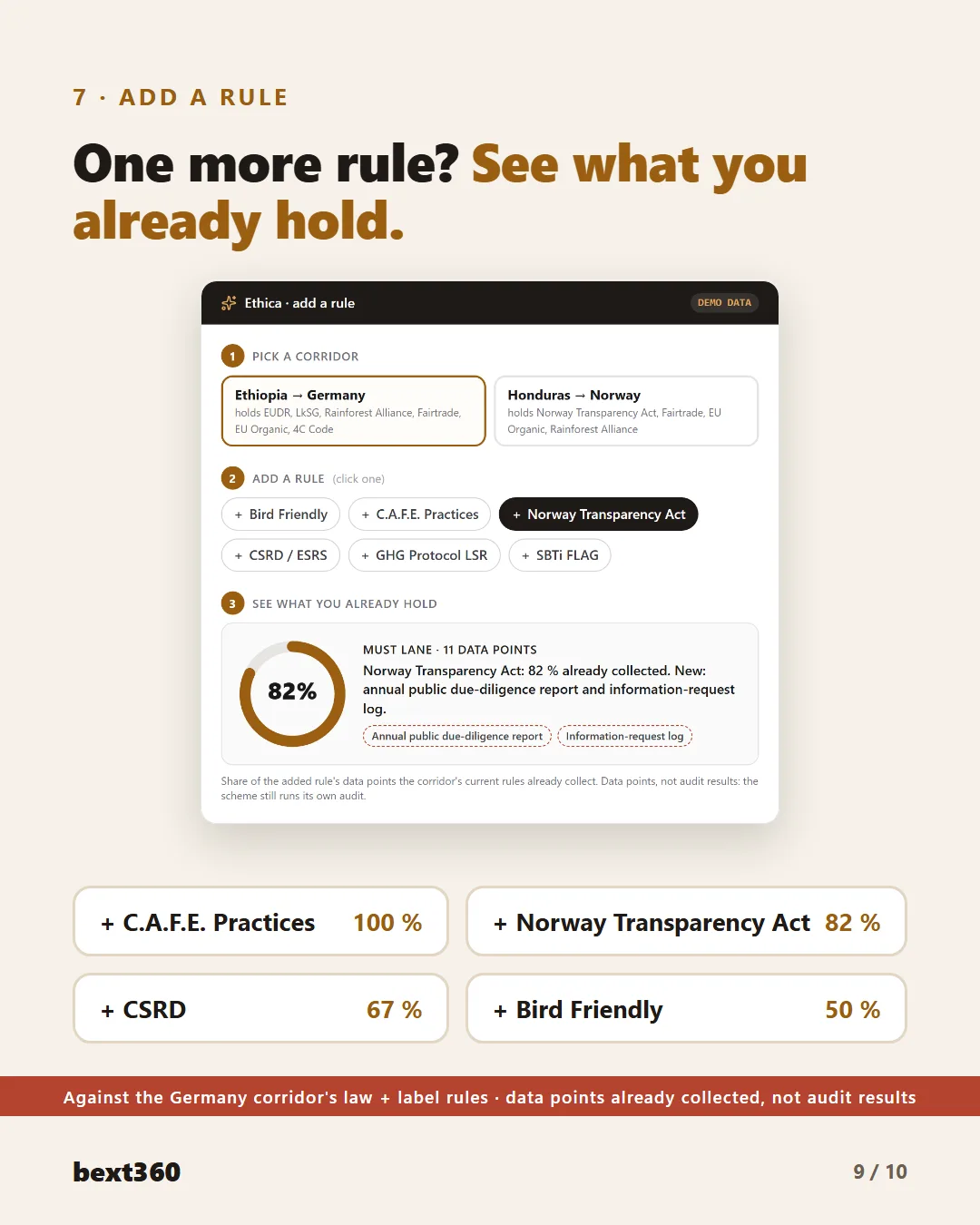
2 Add a rule (click one)
3 See what you already hold
mark lane · 8 data points
Bird Friendly: 50 % already collected. New: shade canopy cover, shade canopy height, shade-tree species and riparian buffer width.
- Shade canopy cover
- Shade canopy height
- Shade-tree species
- Riparian buffer width
mark lane · 9 data points
C.A.F.E. Practices: 100 % already collected. Nothing new to gather; only the scheme's own audit or certificate.
must lane · 11 data points
Norway Transparency Act: 82 % already collected. New: annual public due-diligence report and information-request log.
- Annual public due-diligence report
- Information-request log
report lane · 18 data points
CSRD / ESRS: 67 % already collected. New: farm emissions, transport and processing emissions, land use change emissions, product carbon footprint, land carbon removals and value-chain cap self-declaration.
- Farm emissions
- Transport and processing emissions
- Land use change emissions
- Product carbon footprint
- Land carbon removals
- Value-chain cap self-declaration
report lane · 9 data points
GHG Protocol LSR: 56 % already collected. New: farm emissions, land use change emissions, scope 3 flag emissions inventory and land carbon removals.
- Farm emissions
- Land use change emissions
- Scope 3 FLAG emissions inventory
- Land carbon removals
report lane · 6 data points
SBTi FLAG: 17 % already collected. New: scope 3 flag emissions inventory, land use change emissions, farm emissions, climate transition plan and no-deforestation commitment.
- Scope 3 FLAG emissions inventory
- Land use change emissions
- Farm emissions
- Climate transition plan
- No-deforestation commitment
must lane · 23 data points
EUDR: 57 % already collected. New: due-diligence statement, operator registration, country of production, land tenure evidence, permits and licences, tax and anti-corruption declaration, indigenous peoples consent (fpic), feedstock or fuel type, waste or residue status and feedstock country of origin.
- Due-diligence statement
- Operator registration
- Country of production
- Land tenure evidence
- Permits and licences
- Tax and anti-corruption declaration
- Indigenous peoples consent (FPIC)
- Feedstock or fuel type
- Waste or residue status
- Feedstock country of origin
mark lane · 8 data points
Bird Friendly: 50 % already collected. New: shade canopy cover, shade canopy height, shade-tree species and riparian buffer width.
- Shade canopy cover
- Shade canopy height
- Shade-tree species
- Riparian buffer width
mark lane · 9 data points
C.A.F.E. Practices: 100 % already collected. Nothing new to gather; only the scheme's own audit or certificate.
report lane · 9 data points
GHG Protocol LSR: 56 % already collected. New: farm emissions, land use change emissions, scope 3 flag emissions inventory and land carbon removals.
- Farm emissions
- Land use change emissions
- Scope 3 FLAG emissions inventory
- Land carbon removals
report lane · 18 data points
CSRD / ESRS: 67 % already collected. New: farm emissions, transport and processing emissions, land use change emissions, product carbon footprint, land carbon removals and value-chain cap self-declaration.
- Farm emissions
- Transport and processing emissions
- Land use change emissions
- Product carbon footprint
- Land carbon removals
- Value-chain cap self-declaration
report lane · 6 data points
SBTi FLAG: 17 % already collected. New: scope 3 flag emissions inventory, land use change emissions, farm emissions, climate transition plan and no-deforestation commitment.
- Scope 3 FLAG emissions inventory
- Land use change emissions
- Farm emissions
- Climate transition plan
- No-deforestation commitment
Share of the added rule's data points the corridor's current rules already collect. Data points, not audit results: the scheme still runs its own audit.
The question stayed the same. The penalties did not.
What consumers want
“Where did it come from, and was the farmer paid fairly?”Asked in 2017. Still asked in 2026.
- 44 %
- of US consumer-goods growth came from sustainability-marketed products
- 9.7 %
- more that consumers say they would pay for sustainable goods
- ~60 %
- of business buyers expect to drop suppliers who miss their criteria
NYU Stern CSB and Circana 2025 (sales 2013–2025); PwC Voice of the Consumer 2024; Bain 2024 (within 3 years).
Regulations got serious
- 4 % of turnover
- EU deforestation rule: maximum fine, plus seized goods and revenue
- USD 3.81 billion
- of goods reviewed under the US forced-labour law, over 18,000 shipments
- USD 13.15 million
- paid by Lumber Liquidators under the US Lacey Act for illegal timber
Not knowing is no longer a defence.
EUDR Art. 25 (applies 30 Dec 2026); US CBP UFLPA data, Jan 2026; Lumber Liquidators, 2015.
Too many rules, asking the same things
23
rules for coffee: laws, labels, reports and product claims
284
questions, many of them the same thing in different words
7
groups asking: regulators, certifiers, buyers, investors and more
Without one shared system, every company in the chain answers them by hand, again and again.
The solution · Ethica, since 2025
Add a regulation. Ethica does the rest.
-
1
You add it
Pick a law, a label or a buyer standard, or upload your own.
-
2
AI works it out
Ethica reads every requirement, quotes its clause and finds the data you already hold.
-
3
Adds collection
A simple step where the data lives: at the farm, the mill or the exporter, collected once.
-
4
Reports
Builds the report and the evidence for every buyer and regulator downstream.
284 questions become 68 data points, each collected once, where it happens.
Ethica data dictionary v2.5.0. An analyst approves every requirement the AI extracts.
Two agents protect every customer, 24/7
One watches the rules. One watches the coffee. They collect only what is needed, and make sure it all gets done.
1Watch each loop run 2Click a step to stop on it (click again to resume)
Regulation agent
Keeps every customer ready, 24/7
Proof agent
Checks every lot, every step
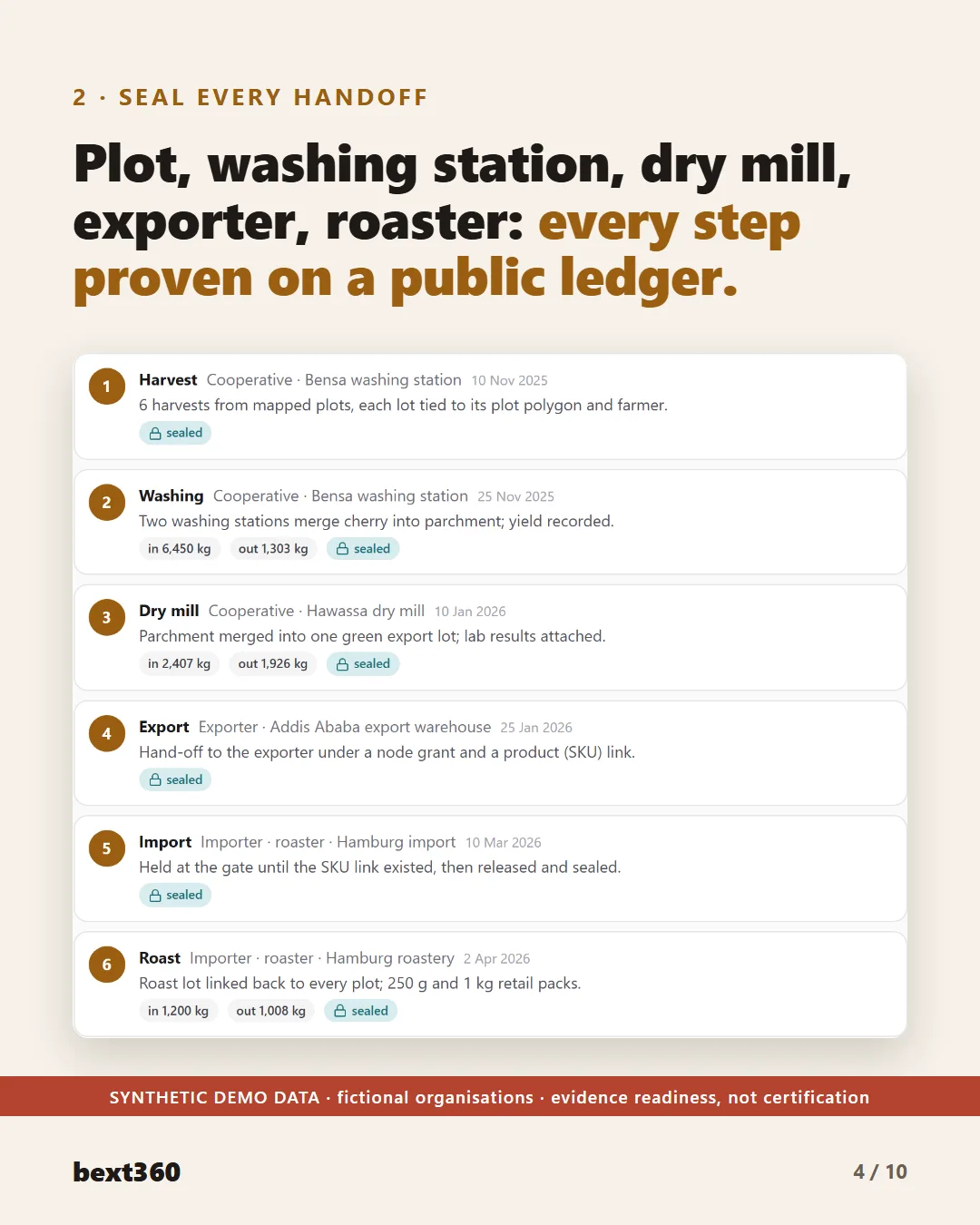
Plot to roast, every hand-off sealed
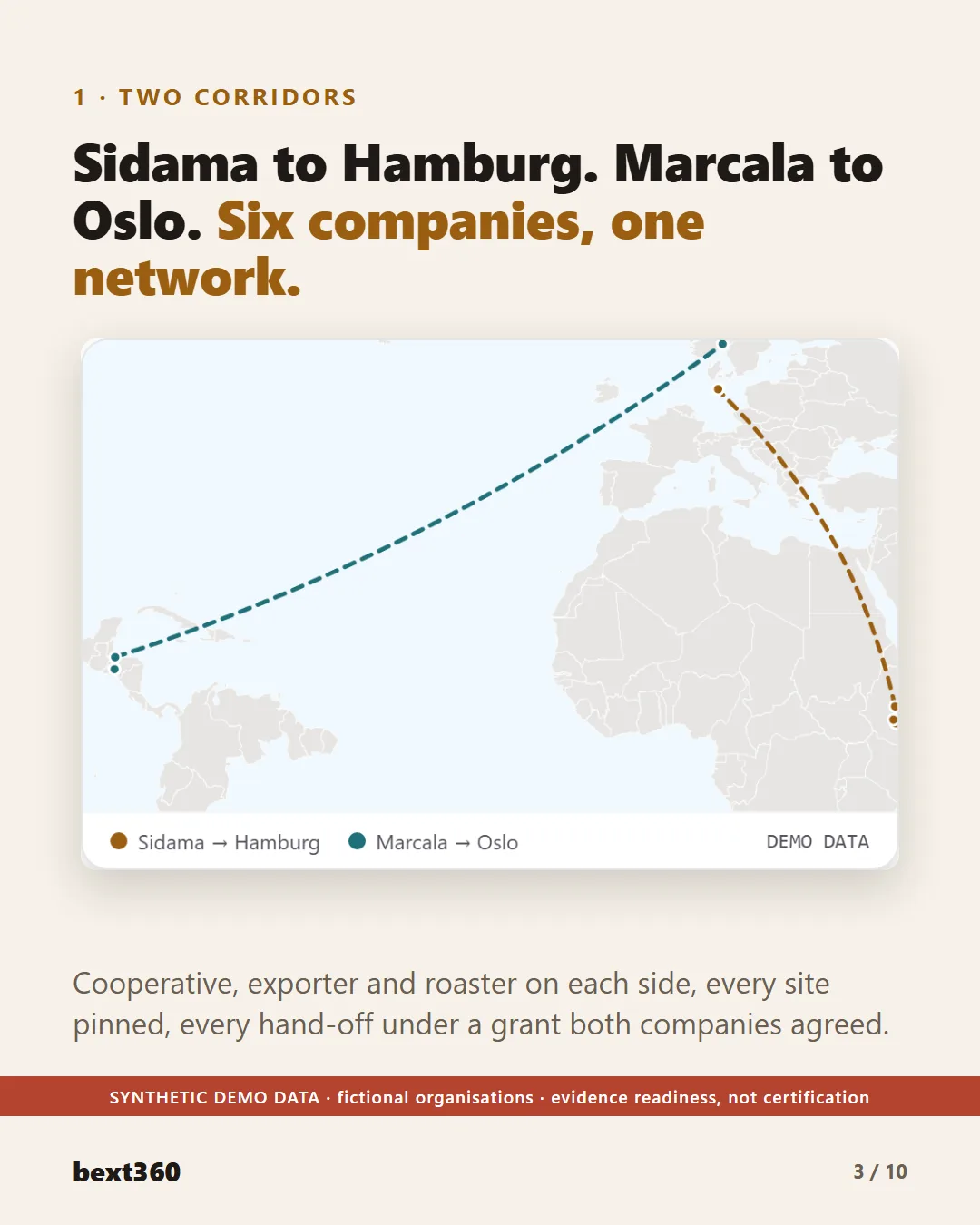
Six demo companies, built with Bext360's Org Manager, trade two lots of green coffee into Europe. Each step is a lot with its kilos, date and documents, sealed on a public ledger before the next one starts. Four contrast lots show what happens when the evidence is not there.
Smallholder cherry from Sidama, washed and dry-milled in Ethiopia, shipped via Djibouti to an importer-roaster in Hamburg.
- 1
HarvestCooperative · Bensa washing station10 Nov 2025
6 harvests from mapped plots, each lot tied to its plot polygon and farmer.
sealed
- 2
WashingCooperative · Bensa washing station25 Nov 2025
Two washing stations merge cherry into parchment; yield recorded.
in 6,450 kg out 1,303 kg sealed
- 3
Dry millCooperative · Hawassa dry mill10 Jan 2026
Parchment merged into one green export lot; lab results attached.
in 2,407 kg out 1,926 kg sealed
- 4
ExportExporter · Addis Ababa export warehouse25 Jan 2026
Hand-off to the exporter under a node grant and a product (SKU) link.
sealed
- 5
ImportImporter · roaster · Hamburg import10 Mar 2026
Held at the gate until the SKU link existed, then released and sealed.
sealed
- 6
RoastImporter · roaster · Hamburg roastery2 Apr 2026
Roast lot linked back to every plot; 250 g and 1 kg retail packs.
in 1,200 kg out 1,008 kg sealed
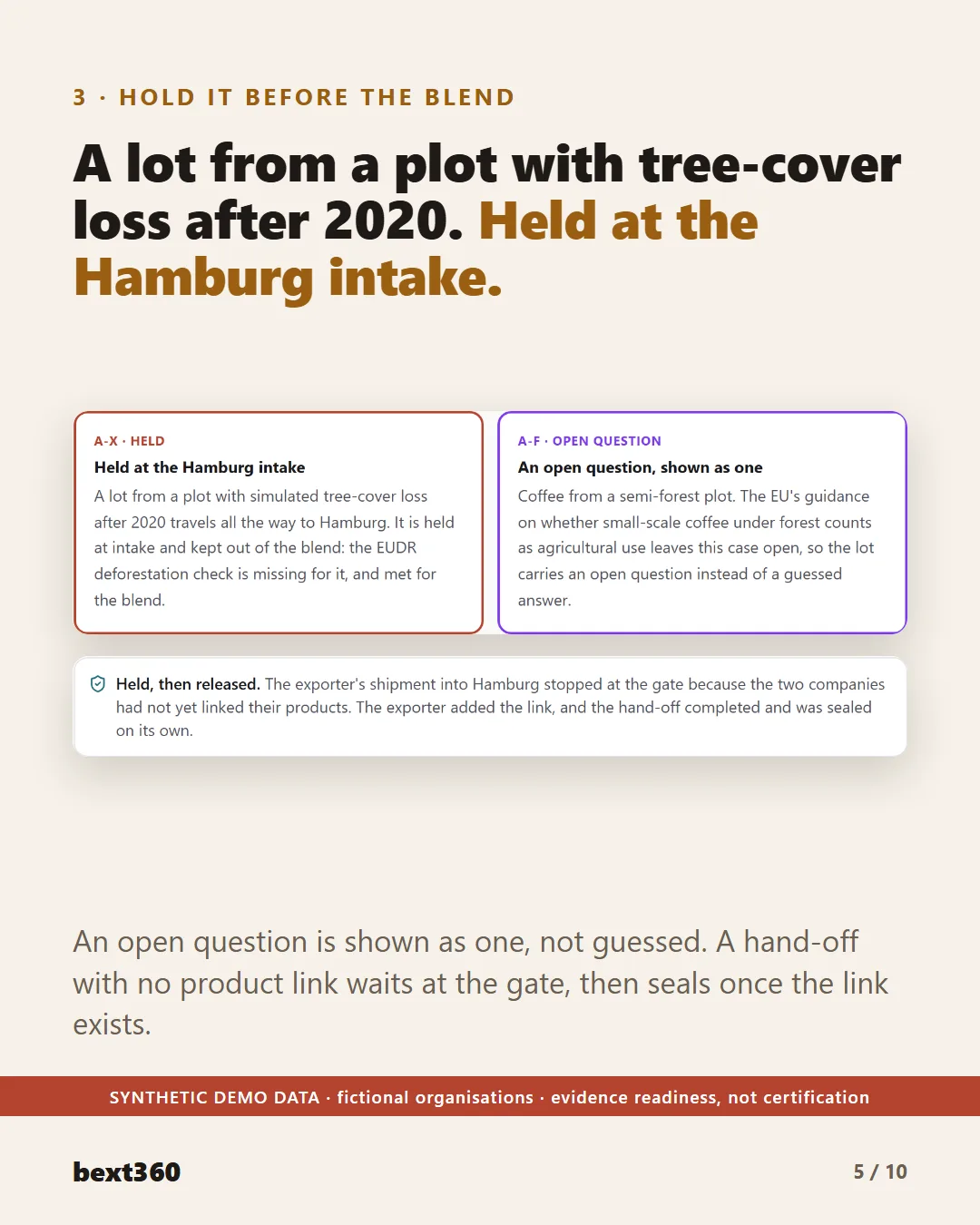
A-X · Held
Held at the Hamburg intake
A lot from a plot with simulated tree-cover loss after 2020 travels all the way to Hamburg. It is held at intake and kept out of the blend: the EUDR deforestation check is missing for it, and met for the blend.
A-F · Open question
An open question, shown as one
Coffee from a semi-forest plot. The EU's guidance on whether small-scale coffee under forest counts as agricultural use leaves this case open, so the lot carries an open question instead of a guessed answer.
Smallholder cherry from Marcala, milled at the cooperative, shipped from Puerto Cortés to a roaster in Oslo.
- 1
HarvestCooperative · Marcala wet mill12 Jan 2026
5 harvests from mapped plots in Marcala.
sealed
- 2
WashingCooperative · Marcala wet mill25 Jan 2026
Wet mill merges cherry into parchment; yield recorded.
in 7,690 kg out 1,530 kg sealed
- 3
Dry millCooperative · Marcala dry mill25 Feb 2026
Green SHG export lot; lab results attached.
in 1,530 kg out 1,224 kg sealed
- 4
ExportExporter · Puerto Cortés warehouse10 Mar 2026
Hand-off to the exporter at Puerto Cortés.
sealed
- 5
ImportRoaster · Oslo import15 Apr 2026
Main shipment into Oslo with its organic certificate of inspection.
sealed
- 6
RoastRoaster · Oslo roastery5 May 2026
Roast lot linked back to every plot; 250 g and 1 kg retail packs.
in 1,000 kg out 840 kg sealed
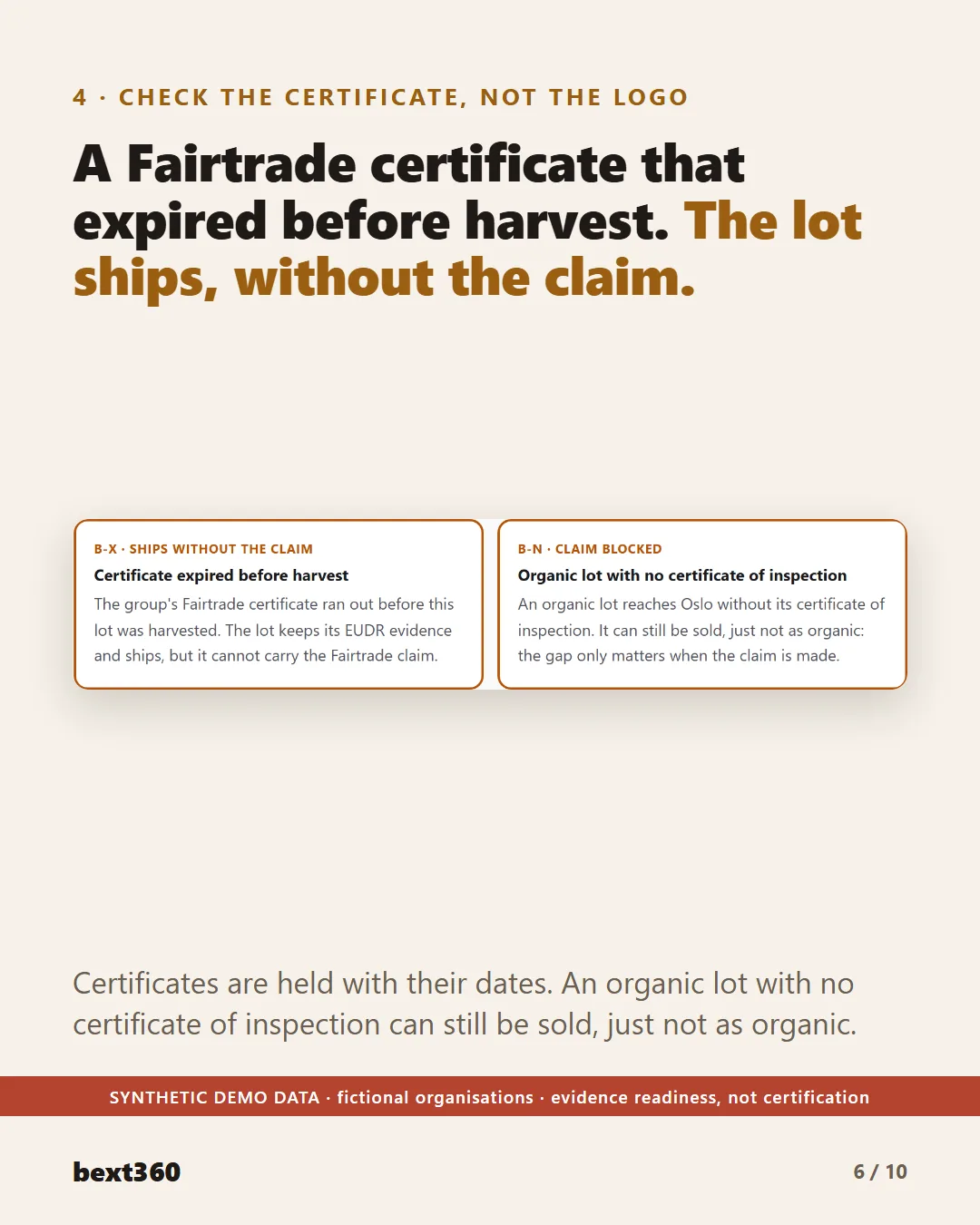
B-X · Ships without the claim
Certificate expired before harvest
The group's Fairtrade certificate ran out before this lot was harvested. The lot keeps its EUDR evidence and ships, but it cannot carry the Fairtrade claim.
B-N · Claim blocked
Organic lot with no certificate of inspection
An organic lot reaches Oslo without its certificate of inspection. It can still be sold, just not as organic: the gap only matters when the claim is made.
Held, then released. The exporter's shipment into Hamburg stopped at the gate because the two companies had not yet linked their products. The exporter added the link, and the hand-off completed and was sealed on its own.
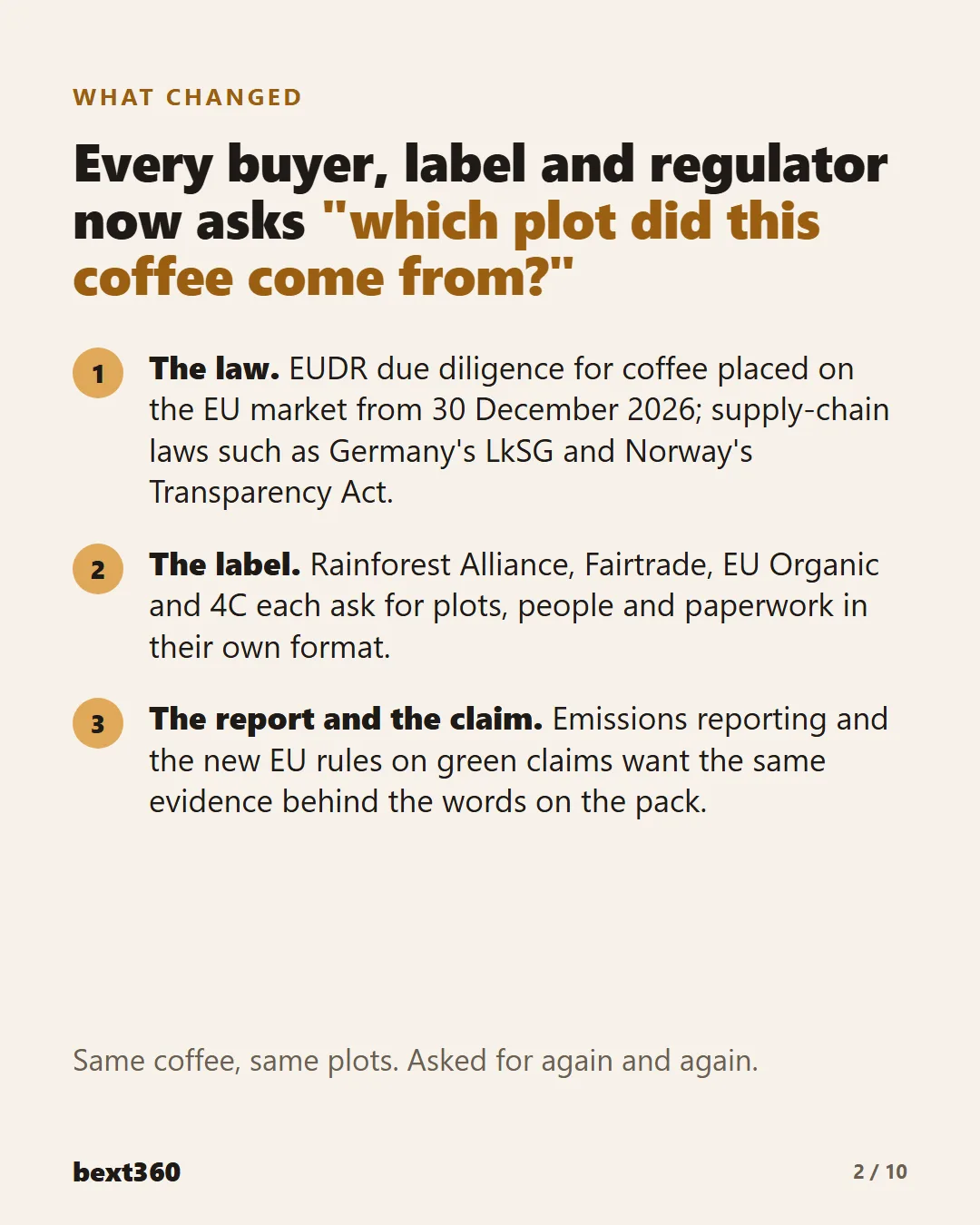
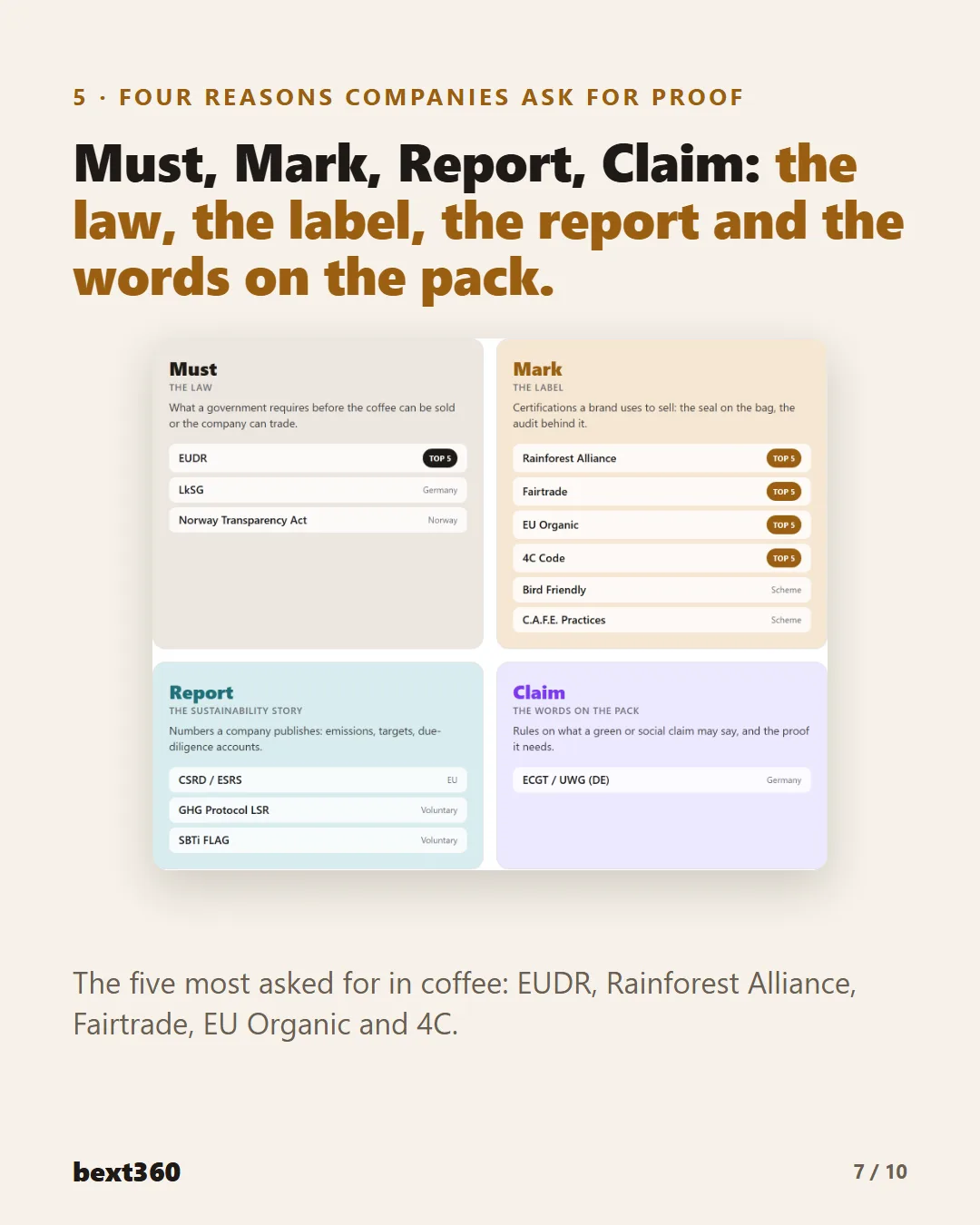
Law, label, report, claim
Every rule a coffee company works to sits in one of four lanes. The five most asked for are marked. Ethica covers all four lanes from the same data.
Must
The law
What a government requires before the coffee can be sold or the company can trade.
- EUDR Top 5
- LkSG Germany
- Norway Transparency Act Norway
Mark
The label
Certifications a brand uses to sell: the seal on the bag, the audit behind it.
- Rainforest Alliance Top 5
- Fairtrade Top 5
- EU Organic Top 5
- 4C Code Top 5
- Bird Friendly Scheme
- C.A.F.E. Practices Scheme
Report
The sustainability story
Numbers a company publishes: emissions, targets, due-diligence accounts.
- CSRD / ESRS EU
- GHG Protocol LSR Voluntary
- SBTi FLAG Voluntary
Claim
The words on the pack
Rules on what a green or social claim may say, and the proof it needs.
- ECGT / UWG (DE) Germany
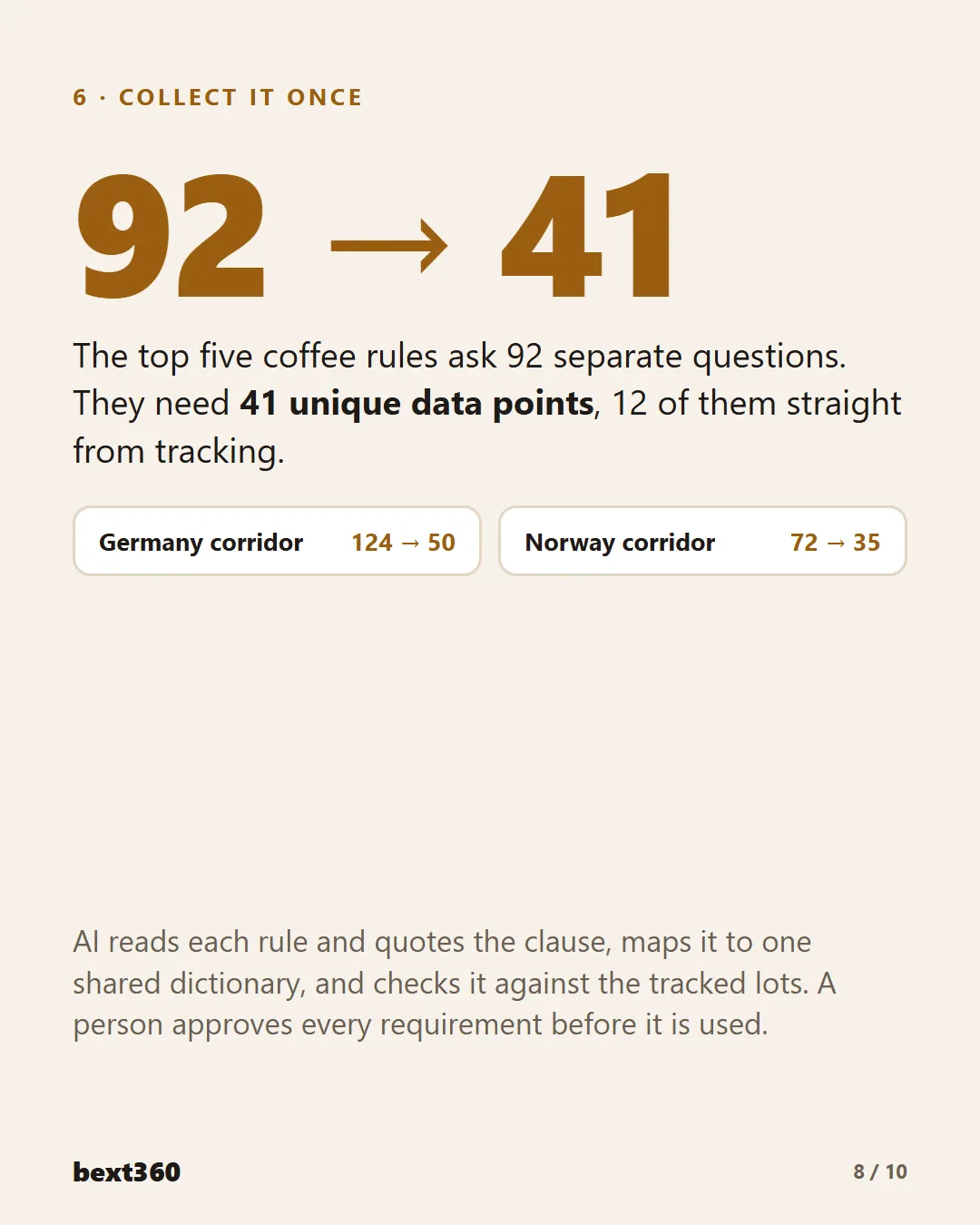
Ask once, answer every rule
Asked one rule at a time, the requests pile up. Mapped to one dictionary, most of them are the same data point asked again.
The Top 5
92 → 41
separate requests → unique data points (55 % fewer asks). 12 come straight from tracking.
EUDR, Rainforest Alliance, Fairtrade, EU Organic, 4C Code
Two corridors · Germany
124 → 50
separate requests → unique data points (60 % fewer asks). 17 come straight from tracking.
EUDR, LkSG, the four labels, CSRD and the claims rules
Two corridors · Norway
72 → 35
separate requests → unique data points (51 % fewer asks). 12 come straight from tracking.
Transparency Act, three labels and land-sector reporting
Counts from the Ethica data dictionary v2.5.0 (50 rules, 113 data points). Readiness, not certification.
Producers get the tools, and coffee worth more
The people who carry the data get something back for it.
Grading at the farm gate
In the Origin app: scan the lot tag, weigh and grade on your own form, add a photo. It works offline; tap Sync back in coverage.
Each measure is checked against your limits, and the grade, weight and place travel with the lot to every buyer.
A simple ERP
Farmers, plots, harvests, lots and payments in one app, even offline.
Providing the data is part of running the business, not extra paperwork.
A product data package
Each lot ships with its key data: origin, plot, deforestation evidence, certificates and payments.
The buyer can sell it into any market without asking again.
~50 %
of business buyers would pay a premium of 5 % or more for products that meet their sustainability criteria
Bain, CEO’s Guide to Sustainability, 2024 (500 companies).
Every requirement met, at lower cost
65–70 %
less staff time collecting compliance data
USD 137,000
saved a year across farmer, trader and roaster
Farmers join free. One subscription covers the whole chain. Run the numbers for your role ↓
Modelled from Ethica rule counts with illustrative inputs; not a measured customer result.
60 to 70 % less time collecting data
The saving comes from the collecting itself: each data point is asked once instead of once per rule, and what tracking already records only needs a quick check. Pick a role and change the inputs.
Farmer cooperative
Sidama, Ethiopia · 5 rules
A cooperative answers the same farm questions for every label and for each buyer’s EUDR file. Asked once, most of them are already in the farm record.
- Rule by rule
- 92
- Asked once
- 29
- From tracking
- 12
No overlap alone removes 55 % of the questions; tracking fills in the rest.
Coffee trader
Exporter / importer, both corridors · 7 rules
An exporter or importer serving both corridors re-asks its suppliers for each rule and each buyer. Asked once, the answers travel with the lot.
- Rule by rule
- 114
- Asked once
- 31
- From tracking
- 13
No overlap alone removes 61 % of the questions; tracking fills in the rest.
Roaster and retailer
Hamburg, Germany · 8 rules
A roaster selling in Germany chases every origin supplier for the law, the labels, the sustainability report and its own claims. Asked once, the evidence is already on the lot.
- Rule by rule
- 124
- Asked once
- 33
- From tracking
- 17
No overlap alone removes 60 % of the questions; tracking fills in the rest.
Time spent collecting compliance data, per year
70 %
less time
Rule by rule
1,520 h
Asked once
457 h
Saved
USD 37,217
1,063 hours
Per supplier: 38 h → 11.4 h a year.
How we calculated this
Rule by rule, each rule asks for its own data points: Farmer 92, Trader 114, Retailer 124 questions per farm or supplier a year. With Bext360 each unique data point is asked once, and each one tracking already records counts as a quarter of a question, for the check. Saving = 1 − (asked once + ¼ × from tracking) ÷ asked rule by rule.
Hours = farms or suppliers × questions × minutes ÷ 60; cost = hours × cost per hour. Weighted by the effort each data point takes (the dictionary's planning estimates), the saving is lower: about 57 % for every role.
Modelled from the rule counts in the Ethica dictionary v2.5.0 with illustrative inputs. Not a measured customer result. Certification fees and audits are not included.
The whole story in 10 pages
Tracked plot to roast, held when the evidence is missing, checked against the law, the label and the report. Swipe or use the arrows; take the PDF with you.
Swipe to turn the page.
Questions people ask first
Where do the 60 to 70 % time savings come from?
Two things. First, no overlap: the same data point (a plot boundary, a harvest date, a certificate) is asked once instead of once per rule, which alone removes 55 to 61 % of the questions. Second, tracking: data points that already come from the tracked lot only need a quick check. Together that is 65 % for a farmer cooperative and 70 % for a trader or a roaster. Weighted by the effort each data point takes, the saving is about 57 %. The hours and costs on this page use illustrative inputs you can change; they are modelled, not measured.
Is this real coffee?
No. The cooperatives, exporters, roasters, farmers, plots and lots are demo data in a Bext360 demo account. The rules, their dates and the way they overlap are real, taken from the official texts and the scheme standards. The ledger seals are real transactions on a public ledger.
Does Bext360 certify coffee?
No. Certification stays with the schemes and their auditors, and legal duties stay with the companies. Bext360 holds the evidence, checks it against each rule and shows what is missing. We say "readiness" and "evidence held", never more than that.
Why is EUDR not a selling point here?
From 30 Dec 2026 every operator placing coffee on the EU market must meet EUDR. Under the EU consumer rules that apply in Germany from 27 Sep 2026, presenting a legal requirement as a special feature of a product is an unfair practice. So EUDR sits in the Must lane: it is the floor, not the story.
Does Norway have to follow EUDR?
Not today. EUDR is not part of the EEA Agreement, so the Oslo roaster works to the Norwegian Transparency Act. The Norway corridor shows EUDR as a what-if: if the coffee is re-exported to the EU, or the rule is taken into EEA law, here is what is already collected.
What does "x % already collected" mean?
Of the data points the added rule asks for, the share the rules you already work to collect too. It counts data points, not audit outcomes: the scheme still runs its own audit, and some rules still need their own certificate or filing.
Which certifications do coffee buyers ask for most?
For green coffee into Europe the five that come up most are EUDR (the law), Rainforest Alliance, Fairtrade, EU Organic and 4C. Bird Friendly and C.A.F.E. Practices are shown as additions.
Demo data. Organisations, sites, people, plots, lots and certificate numbers are invented for this demo; rules, dates and overlaps are real (researched 21 Oct 2026, re-checked before publishing). Schemes are named to describe the requirement sets Bext360 carries; no endorsement or partnership is implied. Nothing here is a certification, a legal opinion or a due-diligence statement.
Bext360 today
Add a rule.The agents do the rest.
Ethica
reads every rule
Regulation agent
watches for changes, 24/7
Proof agent
checks every lot, every step
Producer tools
simple ERP and data package
Readiness and evidence held, not certification.